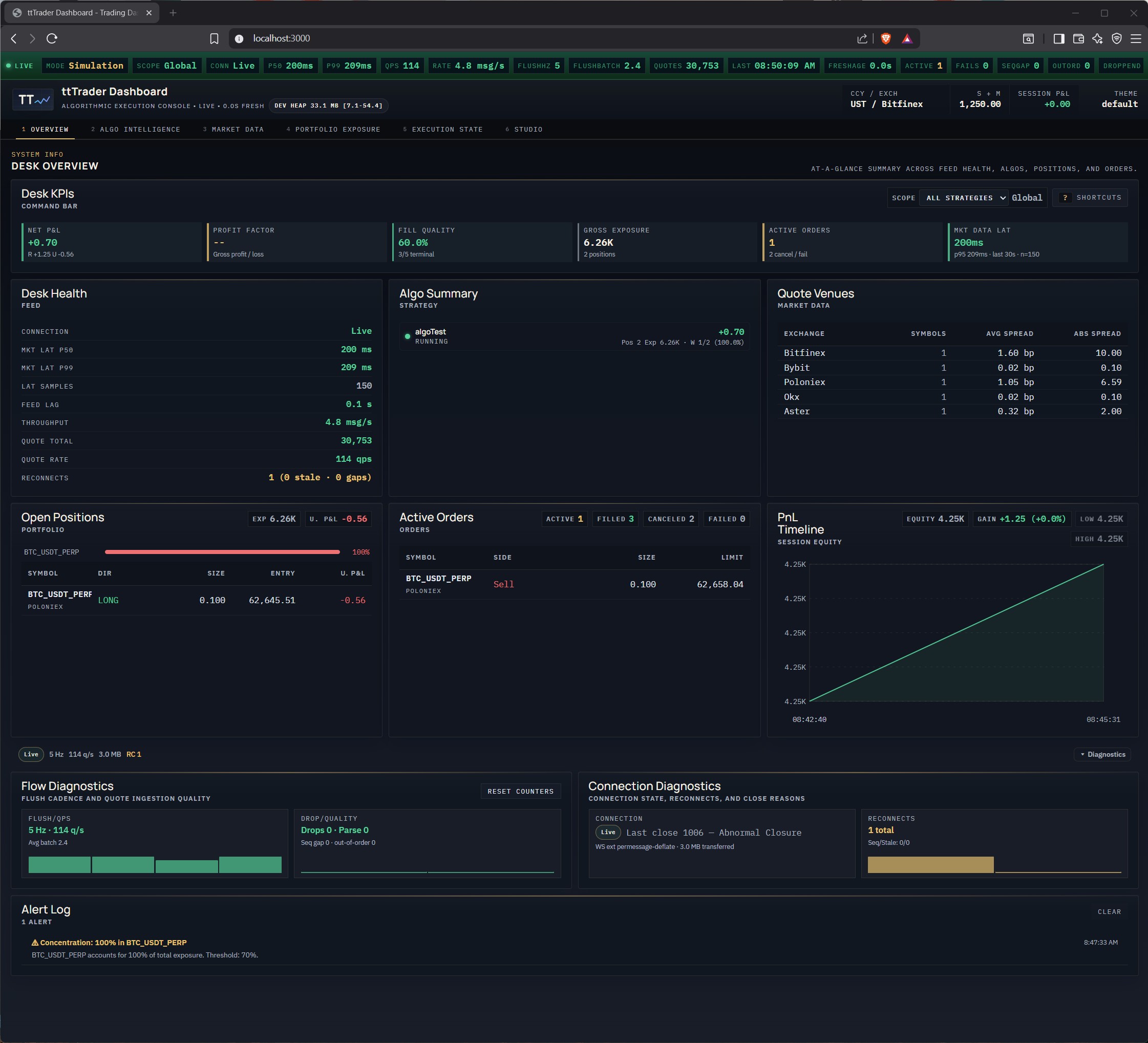
License ttTrader to build, test, and run your own strategies across 15 crypto venues for spot and derivatives, plus stocks, options, forex, and futures through Interactive Brokers (subject to account permissions and data entitlements). We also provide custom engineering and integration services — not signals or managed trading.
Free, time-boxed evaluation of order-submit-to-acknowledgement latency. Test scope is agreed up front; production integration is quoted separately.
ttTrader is a high-performance, multi-exchange algorithmic trading framework built from the ground up in modern C++. It provides everything you need to research, develop, and deploy trading strategies — from tick-level market data to order execution, risk management, and comprehensive backtesting — across crypto venues and traditional brokers: crypto spot and derivatives alongside stocks, options, forex, and futures.
Real-time trades, best bid/offer, and full order book depth (up to 20 levels) from every connected exchange. OHLC candles are streamed natively from the venue — not locally reconstructed — and normalized into a unified data model.
Lock-free data structures, preallocated memory pools, and a custom decimal type for deterministic financial math. The architecture is designed to reduce hot-path overhead; measure end-to-end latency in your target deployment. Optional GPU acceleration via CUDA/OpenCL for compute-intensive strategies.
Trading algorithms compile as independent shared-library plugins (.dll on Windows, .so on Linux). Override virtual callbacks for market data, orders, timers, and positions — your code stays clean and isolated.
Record real market data to binary files, then replay it tick-by-tick through the same event pipeline. The built-in sim venue answers orders with per-exchange latency, depth-aware fills, and maker-tape execution — and learns from your live trading via measured latency profiles.
Built-in risk calculator (BPS, fixed, percent, minimum size), stop-loss engine, position sizing, and pyramiding support. Every order is validated before it hits the exchange.
Runs on Windows and Linux. Deploy locally, on AWS, or collocated near exchange data centers. Multithreaded architecture uses every available core.
Trade crypto on every major exchange — and stocks, options, forex, and futures on Interactive Brokers — from a single unified interface.
Crypto spot, perpetual, and dated futures on the crypto venues; stocks, options, futures, and forex through Interactive Brokers. More exchanges can be added on demand — all with trades, BBO, and order book data.
For HFT and MFT teams, prop firms, and institutional desks building and operating their own strategies.
Rapidly prototype strategies in C++ with full access to tick-level data. The playback engine lets you iterate on years of historical data in minutes. Integrated OHLC bars, 47 built-in technical indicators, and open-ended extensibility.
Deploy latency-sensitive strategies on infrastructure you control. Lock-free data structures and custom memory allocators are designed to limit hot-path overhead; actual latency depends on hardware, network, venue, and deployment. Run multiple strategies across multiple exchanges simultaneously.
Automate complex multi-leg, multi-exchange trading workflows. The position manager tracks every fill across every instrument. Risk limits are enforced globally. Pyramiding and scaled entry/exit patterns are first-class features.
Need a custom exchange connector? A specialized order type? A second opinion on your algo? Or a complex GPU-accelerated algo running on CUDA/OpenCL? We offer consulting and custom development services built on top of the ttTrader framework — from strategy design to production deployment and ongoing support. Explore all offers →
We offer a free, time-boxed evaluation of the path from your strategy's order submission to exchange acknowledgement. Scope is agreed up front and covers one venue and one test setup.
Annual license for the full ttTrader framework: all exchange connectors, playback engine, dashboard, and plugin SDK. Includes updates and priority bugfixes.
Custom trading algorithms implemented on request — describe your strategy and receive a quote. Need a venue that isn't supported yet? Commission a new exchange or broker connector with agreed scope, deliverables, and validation criteria. Development is quoted before work begins; production framework licensing and any ongoing maintenance are quoted separately. Request a connector quote →
Algo development, algo analytics and review, connectors and integrations, training and onboarding — delivered directly by the ttTrader developer. See all services →
A framework engineered for performance and correctness from day one.
.ttpb binary files, then replay it through the
same strategy and event pipeline used in live trading. The simulation venue
approximates order execution; queue position, network conditions, and live fills can still differ.
Binary floating-point can't represent most decimal values exactly. The classic
0.1 + 0.2 ≠ 0.3 — on every machine, every language:
0.1 + 0.2 returns 0.30000000000000004 in
double, and float is even worse.
In trading that tiny error compounds over millions of fills — drifting your
P&L, mispricing fees, and failing bit-for-bit reproducibility audits.
ttTrader uses a proprietary decimal_t type: fixed-point, base-10,
deterministic to the last tick. The same computation gives the same
answer, always, across runs and platforms.
Market data flows through a lock-free circular buffer chain. Trades, BBO updates, and order book snapshots are dispatched to strategy callbacks without a mutex in the hot path. This reduces one source of synchronization overhead; measure end-to-end performance in your target venue and deployment.
A sharded, short-term memory pool avoids malloc/free entirely for
allocations
up to 32 KB. Four independent shards with thread-local affinity and lock-free round-robin
selection
eliminate contention. Free blocks are merged on release to prevent fragmentation; idle segments
are reclaimed back to the OS under backpressure. Best-fit search with auto-tuning adapts to
allocation patterns in real-time.
From every closed trade the system extracts evidence, tunes its own gates and exits, and measures before it serves — plus a shared base-class machinery with ML & NN components, a versioned protocol, and a self-describing build.
algoValueFeedback_c self-tunes entry gates, algoExitShape_c learns a
bounded stop/hold pair, algoExitCounterfactual_c replays closed trades to find the
exit that would have done best, and algoParticipationGate_c learns whether to
stand down, reduce, or trade at all.
algoPromotionPolicy_c) decides PROMOTE / HOLD / DEMOTE over realized labels, a
trusted-PnL boundary keeps a mis-scaled number from poisoning learning, and
algoStageLadder_c gates learning cadence across an observe → probe → refine → serve
stage ladder — its floor binds the transition out of the current stage, so observation
gates on observed data rather than matured labels.
Base-class machinery: position management, learning, risk kernels, HMM regime detection,
bandits, and offline training ship in ttAlgoStatic. Every strategy inherits a
safe, self-tuning core without copying it.
A strictly causal feature vector and a shadow posterior gate that can only stand an algo down — never force a trade.
Deterministic time-series CV with Platt and Mondrian-conformal calibration, emitting byte-identical versioned weight bundles.
Per-contract, validate-then-commit persistence with contract fingerprints — a state file can never apply another contract's learning.
What ttTrader runs on, and what it needs from your infrastructure.
Windows 10/11 or Linux (GCC/Clang), C++23 toolchain (MSVC recommended on Windows). No GPU required — CUDA/OpenCL is optional for compute-heavy strategies. For competitive latency we recommend colocation near exchange matching engines; ttTrader runs unchanged on bare metal, VMs, and AWS.
Answers to the questions we hear most from quants, prop firms, and development teams.
.ttpb
files, then replays it through the same strategy and event pipeline used in live trading.
The simulation venue approximates order execution; queue position, network conditions,
and live fills can still differ.
Interested in the framework? Looking for a technology partner? Let's talk.
+49 1522 3848 517
Droste TradeTec UG (haftungsbeschränkt) & Co. KG
Oskar-Knufinke-Weg 5
58456 Witten
Germany